Growing Your Startup Feels Like an Uphill Battle? The Real Cause and a Clear Way Forward
Growing your startup feels like an uphill battle for many founders. Learn the real cause behind stalled growth and a clear, structured way forward. Grow Your Startup Today!

Mike Parsons
Founder, Apollo Advisors°
Over the past twelve months, I have reviewed over 400 startup pitch decks and had hundreds of conversations with founders at various stages of their journey. I have also mentored four finalists who went on to present at the Silicon Valley finals organised by Pegasus Tech Ventures.
Across early-stage teams, funded scale-ups, and founders on global stages, one pattern repeatedly emerges.
Building a startup is challenging.
Most startups do not gain traction early, and most founders are quietly trying to understand why. They are building products they genuinely believe in, hiring thoughtfully, and putting themselves out into the market. Yet, momentum does not come as they expect.
What I hear most often in these conversations is not frustration or blame. It is confusion. Founders sense that something is wrong, but they cannot clearly identify where the issue lies. They ask what to fix, what to change, and where to focus next.
In nearly every case, the problem is not effort, intelligence, or ambition.
It is orientation.
The Insight Most Founders Miss
The most consistent pattern I observe is that founders often do not fully understand the fit model or where they currently fit within it. They are familiar with the language of problems, products, markets, and growth, but lack a clear view of which stages are proven, which are still assumptions, and which might have been skipped entirely under pressure to advance.
Consequently, essential steps are frequently bypassed. Teams keep executing, not because the foundation is in place,e but because expectations, investors, or internal momentum require progress. This is where growth begins to feel burdensome. Effort increases, but confidence does not. Activity rises, yet clarity remains hard to find.
What Resistance Is Really Telling You
Growth rarely becomes difficult without a reason. When progress feels slow or strained, the market is usually giving feedback that hasn't yet been fully understood. Most teams respond by stepping up activity. Budgets are increased in the hope that more visibility will reveal demand. Additional channels are added to cover those that aren't performing well. Sales teams are pushed harder to convert interest that isn't fully developed.
This generates movement, but not clarity.
What is really happening is that effort is being used to cover uncertainty. Instead of reducing ambiguity, the system absorbs it and tries to forge ahead. Teams stay busy, but the direction remains unclear.
Resistance isn't solved by pressure. It is solved through understanding.
The Truth Gap Beneath Most Growth Struggles
Most growth challenges stem from a single gap: the divide between ambition and evidence. Teams often press ahead with answers to key questions that haven't been adequately tested.
- Is the problem excruciating for a well-defined group?
- Do buyers see themselves in the problem without needing an explanation?
- Is demand apparent before persuasion starts?
- Does the business model actually hold up under real-world conditions?
When these questions go unanswered, execution is forced to fill the gaps. Marketing has to persuade rather than clarify. Sales need to convince rather than align. Investment is used to cover uncertainties rather than enhance strengths. The system becomes effort-driven instead of structure-led, and growth begins to feel like resistance.
Why Pushing Harder Rarely Helps
When growth slows, the natural response is to boost output. Budgets increase, channels expand, and pressure builds across the organisation. While this can generate short-term activity, it rarely leads to long-term clarity.
Without structural alignment, added effort causes friction rather than momentum. Teams appear active but lack effectiveness. Decisions become reactive rather than strategic. Progress becomes more driven by pressure rather than by pull.
This is not a failure of discipline or execution.
It is an architectural issue.
When the core truths of the business are not made explicit, execution carries a burden it was never meant to bear. The organisation begins to work against itself.
A More Sustainable Way Forward
Growth feels lighter when it follows a sequence rather than rushing ahead.
There is a sequence that consistently reduces resistance.
- First, confirm that a real and urgent problem exists.
- Next, verify repeatable demand, retention, and willingness to pay.
- Then, test whether the business model can support scale without breaking under pressure.
- Finally, confirm that demand is visible before applying persuasion, outbound efforts, or spending.
When these truths are evident, execution becomes simpler. Marketing explains instead of persuading. Sales align instead of push. Investment amplifies what already works rather than trying to fix what doesn't.
Momentum becomes a result of structure, not just effort.
Why I Built the Free Apollo GPTs
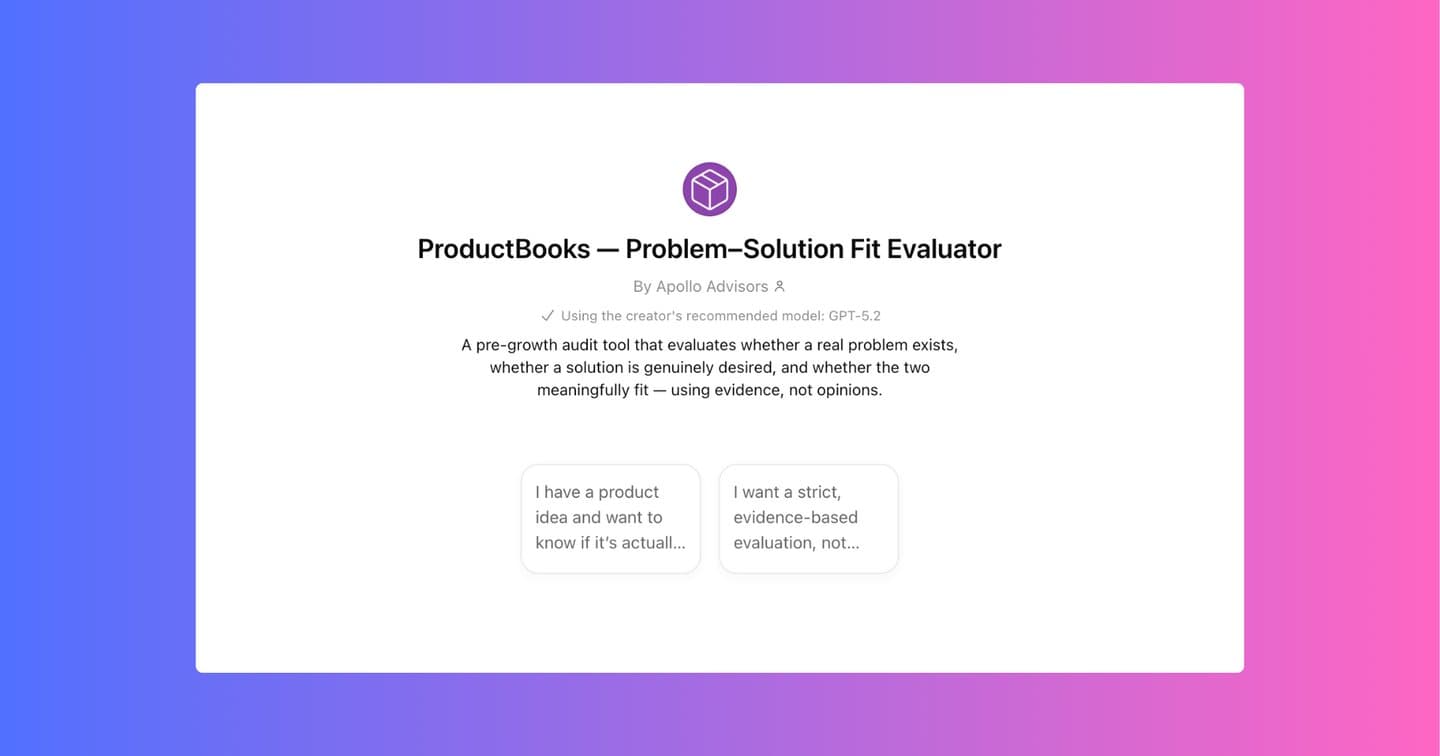
After observing this pattern repeat countless times, one conclusion became clear. Founders don’t need more tactics; they need clarity. They require a way to discern which truths are proven, which are assumed, and which are missing before deciding what to do next. That’s why I created a set of free Apollo GPTs.
Each tool is designed to test a specific truth in the proper order, relying on evidence rather than opinion. They aren’t meant to motivate, persuade, or promise outcomes; they aim to clarify reality.
Related insight
Continue the system thread.
New Episode: Colin Kinner — 20 Years of Startup Lessons, AI Coaching & Building Better Founders
Discover 20 years of startup lessons from Colin Kinner on AI, founder mindset, startup validation, product-market fit, and building better companies.
4 Things That Make Your Startup Pitch Fundable (After 400+ Reviews)
4 proven ways to make your startup pitch fundable, based on 400+ pitch deck reviews. Learn what investors actually look for.
GTM Sydney
If your GTM isn’t working, investors already know. Join our Sydney session to diagnose your funnel, fix your system, and make your startup fundable.